
What people say. What people do.
Suppose a shopper says price mattered most, while the observed journey shows several visits to product-detail pages.
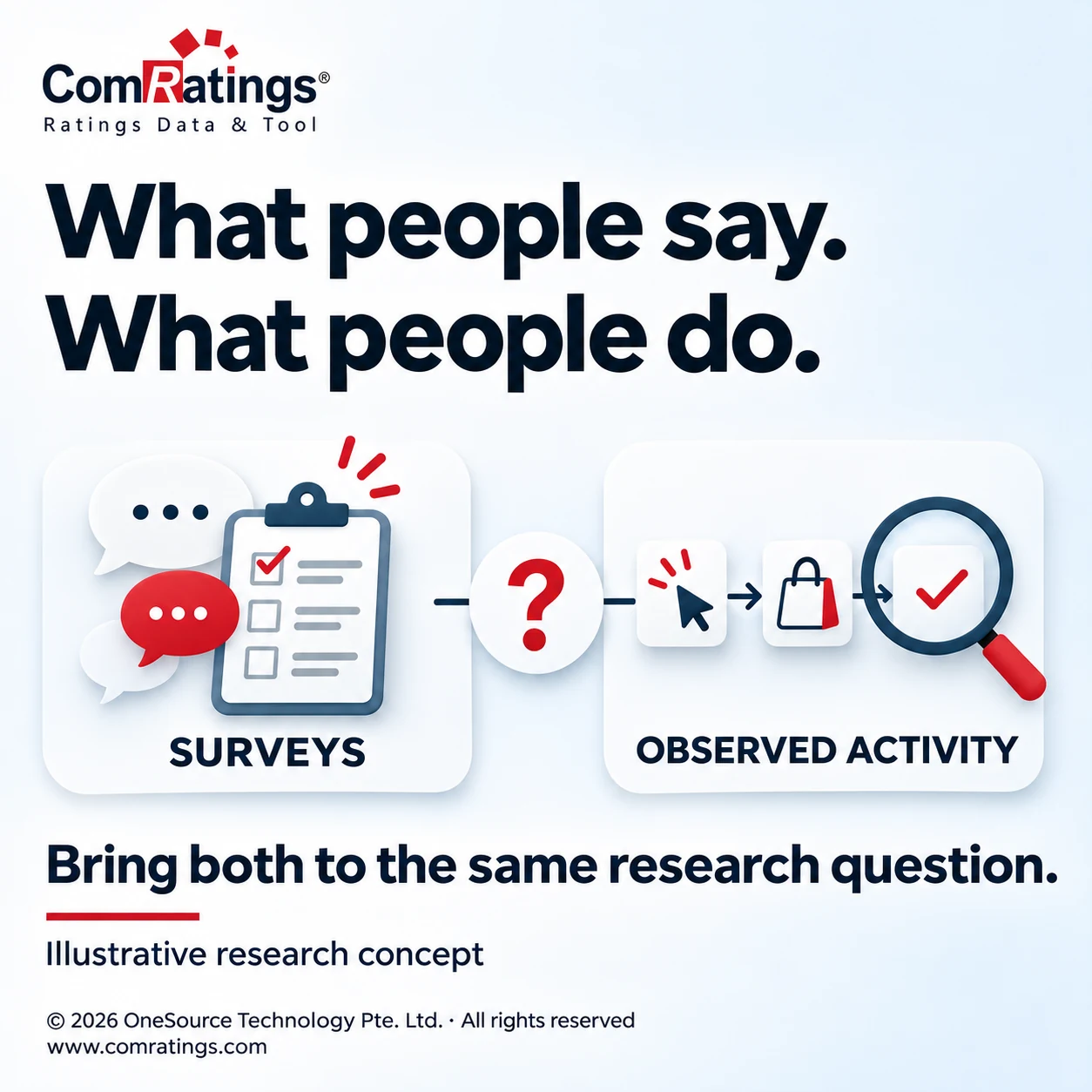
Those findings can coexist. The visits do not tell you what the shopper was thinking, and the survey answer is their own explanation of the choice.
Bring two sources to one research question
Surveys help explore needs, preferences and stated reasons. Behavioral research, with participant consent, adds the sequence and context of observed activity.
Check an apparent disagreement
When the two seem to disagree, check the dates, coverage and question wording. The difference may be the most useful question for the next study.
Start with a suitable research plan
In OmniROI, teams can begin with surveys and their own participants. A Basic workspace is free with no expiry. Recruitment, participant rewards and advanced analysis are charged separately.
Compare surveys and behavioral research · Basic workspace features and limits · Plan comparable research waves · Research methods and scope · Discuss a study